

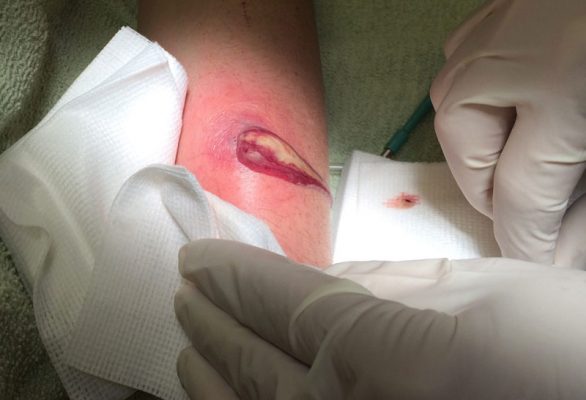
Signs of an infected ulcer
The skin acts as a protective barrier for the body against external agents. When an open wound appears, that barrier loses its inherent protective ability because it is damaged. If the number of bacteria attacking is too high for the immune system to fight off, an infection can easily occur. Below are some signs to recognize when an ulcer is infected by bacteria.

- Fever
This is a very normal reaction of the body when an inflammatory response occurs. When encountering a severe wound, your body may have a mild fever below 38 degrees Celsius. In cases of high fever over 38 degrees Celsius that persists, this is a sign that the ulcer has become infected. You need to pay attention to this sign to have the most timely and effective treatment.
- Wound pain- swelling- redness and heat
The wound may be accompanied by signs such as swelling- redness- heat- and burning. Note that this is a sign that an inflammatory response is occurring very strongly. Your body is having to fight off a large amount of bacteria attacking the site of the injury.
- Wound discharging a lot of fluid and having an odor
Normally, open wounds will secrete clear/slightly yellowish fluid. When the ulcer is infected, the secreted fluid will change color, such as: dark yellow or green. Along with that, it will be accompanied by an unpleasant odor. It is necessary to monitor the wound daily to timely recognize this change.
- Increased pain sensation
A pain sensation that does not subside but increases is a warning sign of an infected ulcer that cannot be ignored. Normally, the pain only peaks on the 2nd day after injury and gradually decreases in the following days. If you find that the pain does not improve and even increases compared to before, you should also take note and need intervention from a doctor because the wound is highly likely to be infected.
- Body fatigue
When your body is constantly attacked by a large number of harmful agents, a feeling of fatigue/weakness is inevitable. Along with that, you will also feel aches and pains, loss of appetite/no desire to eat.
Are infected ulcers dangerous?

Infected ulcers take longer to heal than other wounds
Infection is an acute state. If not detected and handled in a timely manner, it will leave unpredictable consequences. A prolonged infected ulcer condition will seriously affect the patient's health and life directly.
- Wound leaves bad scars
Wound infection will cause deep damage to the underlying skin layers and spread. Therefore, during the recovery process after the injury, there is a very high risk of leaving bad scars. Depending on the location and severity of the infected ulcer, different types of scars will appear such as: pitted scars, keloids,....
- Cellulitis
This is considered the most common acute bacterial infection of the skin and subcutaneous tissues caused by Staphylococci or Streptococci. Cellulitis will cause: swelling- redness- pain in the affected skin areas. In cases of severe infection, the patient may have a fever and have swollen lymph nodes in that area.
- Necrotizing fasciitis
This is a serious ulcer infection caused by the bacterium Aeromonas Hydrophila. This is a bacterial strain capable of destroying muscle tissue as well as causing necrotic damage very quickly. The consequence is that the patient will have to endure terrible pain spreading throughout the body.
- Sepsis
Sepsis is a condition where the infection has become very severe, and the mortality rate will be very high. According to medical experts, if one can survive after having sepsis, the mortality rate within 1 year can still be up to 26%. From there, it can be seen that this disease will leave many dangerous and severe sequelae for the patient such as: reduced mobility, lack of mental clarity, cognitive decline....
With injuries that have eaten deep and spread, the rate of sepsis will increase. Therefore, it is necessary to treat the wound as soon as possible to avoid dangerous consequences later on.
How long does an infected ulcer take to heal?
Depending on the severity as well as the location of the infection, the recovery time of the injury will be different. If detected and treated properly and in a timely manner, the wounds will quickly scab over and begin to form new skin a few days later. For severe wounds, it takes longer care time along with specialized treatment measures.
Is it necessary to take antibiotics when an ulcer is infected?

Infected ulcers should be treated with antibiotics (as prescribed by a doctor)
For wounds/ulcers infected by bacteria, the use of additional antibiotics is necessary. However, the use of medication needs to be guided by a doctor because:
- Using antibiotics indiscriminately on your own will lead to bacterial antibiotic resistance.
- Typically, a course of antibiotic use lasts from 7-10 days.

-
Hydrofiber technology helps lock in bacteria and exudate, minimizing cross-infection and protecting the skin surrounding the wound.
-
Silver ions are released for up to 14 days, maintaining local antibacterial effects.
Aquacel Ag+ Extra dressing

• Ag+ technology helps break down the biofilm so that Silver ions can easily kill bacteria and prevent the biofilm from reforming.
• Hydrofiber technology helps lock in exudate and bacteria, minimizing cross-infection and protecting the skin surrounding the wound.
• Significantly kills biofilm and helps epithelium form faster compared to conventional impregnated dressings.
• Helps reduce ulcer size by 70% in infected ulcers.